
Choosing the right UV flatbed printer is not about buying the most advanced machine, or the largest one that fits your floor. The better question is what your shop actually needs to print.
UV printing opens a wide range of materials, but the way a printer handles those materials is what separates one format from another. Roll-to-roll systems are built around flexible media fed from a roll. Flatbeds hold rigid material still on a bed and move the printheads across it. Hybrid systems do both.
Start With the Work You Produce and the Work You Want to Add
Choosing between roll-to-roll, flatbed, and hybrid UV is easier when you look at both your current production and the opportunities you want to bring in-house. Consider:
- What do you print today?
Identify the flexible and rigid media you already run, and where UV could fit into that workflow. - What do you want to start offering?
If you're adding UV to an eco-solvent shop, for example, think about whether your goal is to expand into rigid signage, specialty products, décor, or other applications. - How often will you print rigid materials?
If rigid work is becoming a regular part of your business, a UV flatbed printer may make more sense than adapting a roll-based workflow. - How large are your typical jobs?
Long, continuous graphics favor roll-to-roll, while individual sheets, panels, and objects suit a flatbed better. - What materials do your customers request?
Your substrate mix can help determine whether you need a roll-to-roll, flatbed, or hybrid format. - How much space do you have?
Consider not only the printer footprint but also the room needed to load, stage, and move rigid materials. - Where does the finished work end up?
Schools, offices, and healthcare spaces raise the value of low-odor output.
Why Water-Based UV Changes the Roll-to-Roll Question
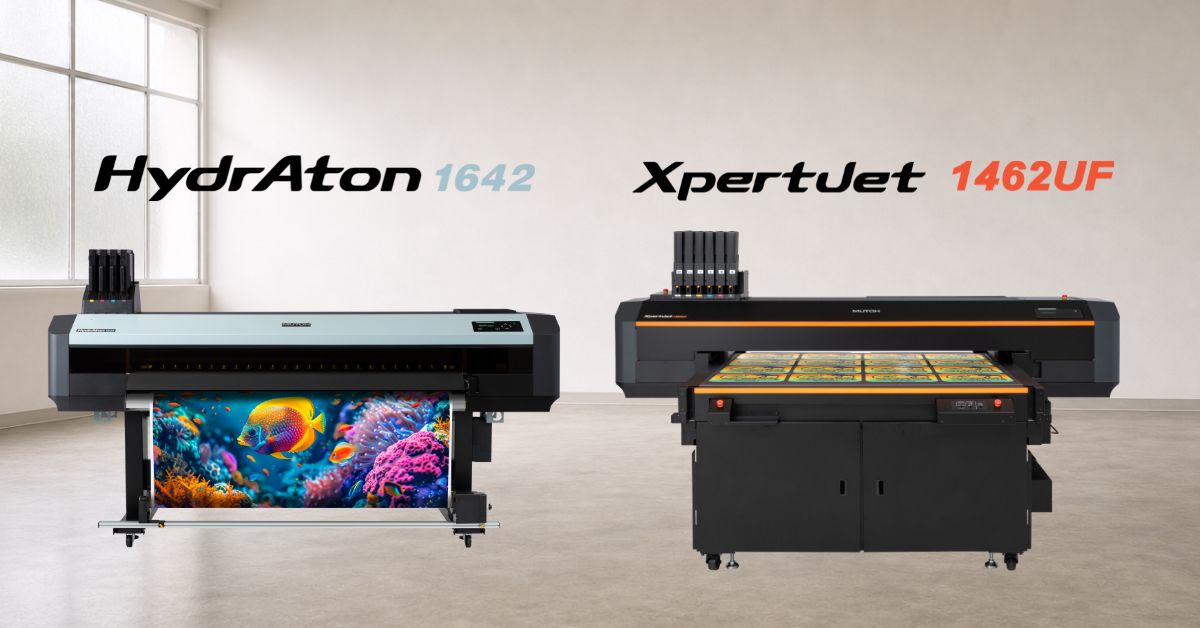
Roll-to-roll UV printing can use different types of ink technology. The HydrAton 1642 is a 64-inch water-based UV printer that combines roll-to-roll production with a water-based UV ink system. It prints in four colors, and feeds finished prints onto a take-up roll during production.
The ink has low VOCs and low odor and is GREENGUARD Gold certified. It cures at 30 to 50°C, helping reduce media shrinkage when printing on heat-sensitive materials. It also requires no optimizer or overcoat before printing or clear coat after printing.
When a UV Flatbed Printer Makes More Sense
A UV flatbed printer can be a strong fit when rigid materials, individual objects, or specialty applications are becoming an important part of your business.
Instead of feeding material from a roll, a flatbed holds the substrate securely on the table during printing. This makes the format well-suited for applications such as:
- Sign panels.
- Retail displays.
- Door and wayfinding signage.
- Awards and promotional products.
- Specialty décor.
- Rigid boards and panels.
- Direct-to-object printing.
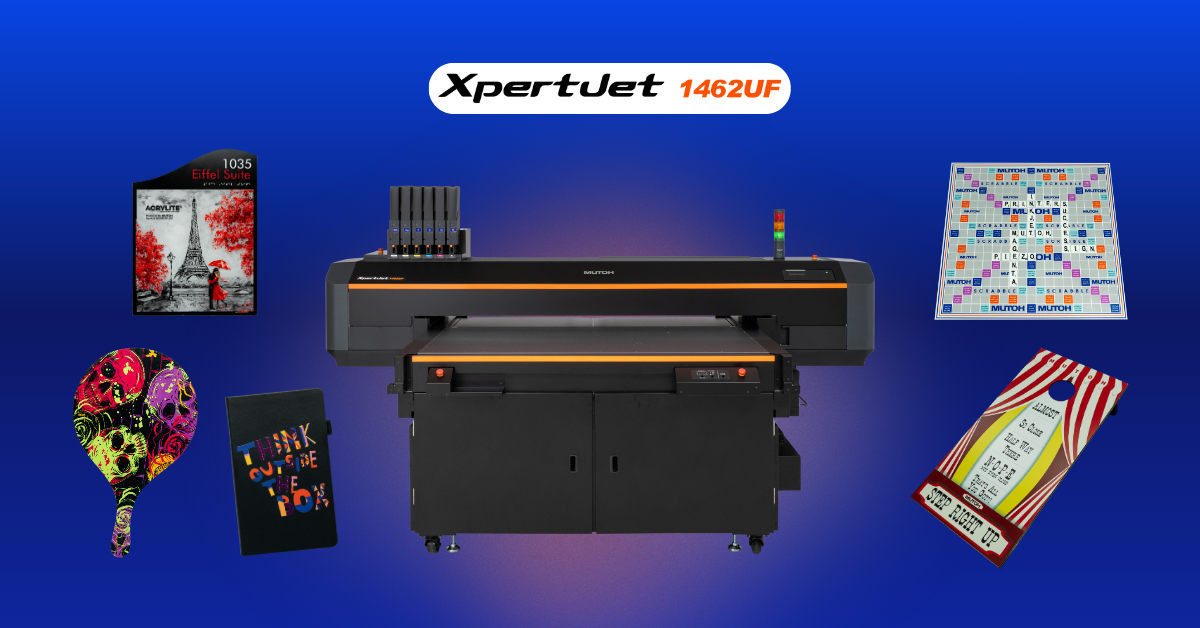
The MUTOH XpertJet UF flatbed models can print on objects up to 5.9 inches thick, expanding production beyond standard flat sheets.
When every job involves a different object, substrate, or quantity, a flatbed can make that variety easier to manage.
White and Varnish Open New Revenue
Another advantage of UV flatbed printing is the ability to use specialty ink configurations for applications that go beyond standard CMYK graphics.
MUTOH flatbed models can be configured with white and varnish. White ink allows graphics to be printed on colored or transparent substrates, while varnish can be used for effects such as gloss, matte finishes, and layered textures.
These capabilities can also support specialty applications such as ADA-compliant braille and dimensional effects, helping shops produce more than standard printed graphics in a single production workflow.
For businesses already receiving requests for specialty finishes, direct-to-object printing, or customized products, these capabilities can be an important part of the equipment decision.
What If Your Shop Needs Both?
Not every shop fits neatly into a roll-to-roll or flatbed category.
If you regularly produce flexible graphics but also want to take on rigid applications, a hybrid printer can provide both capabilities on one machine.
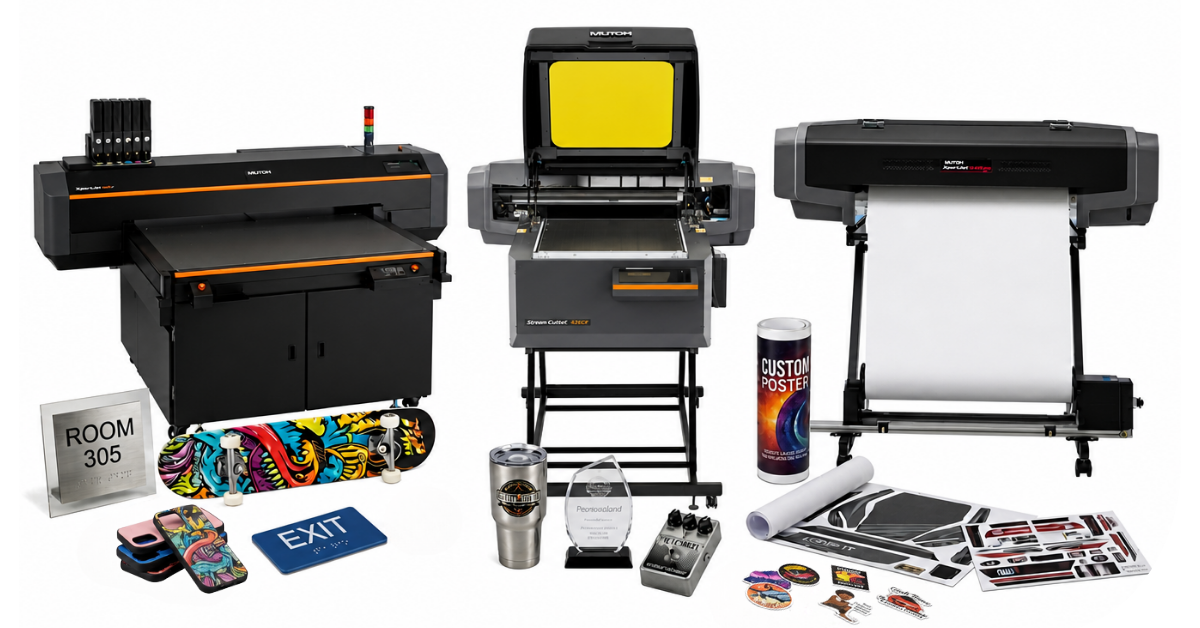
The ValueJet 1638UH Mark II is a UV hybrid that handles roll media as well as rigid objects or substrates up to 0.50 inches thick. Its media thickness detection sensor and retainer guides help simplify rigid-media setup.
A hybrid can make sense when a shop needs both roll and rigid capability but isn't ready to dedicate separate equipment to each workflow. It can also provide a way to expand into rigid applications while continuing to support existing roll-based production.
Comparing the Three MUTOH UV Printer Formats
|
Consideration |
Roll-to-Roll UV |
UV Flatbed |
Hybrid |
|
MUTOH Printers |
|||
|
Media |
Roll media. |
Rigid substrates and objects. |
Roll and rigid substrates. |
|
Media Thickness |
Up to 1 mm |
Up to 5.9 in. |
Up to 0.50 in. |
|
Specialty capabilities |
Water-based UV ink, low-VOC, low-odor output. |
White and varnish options; specialty applications including ADA-compliant braille. |
Runs with rigid UH21 or flexible US11 ink. |
|
Best fit |
Shops focused on roll-to-roll applications where low odor and low VOCs are important. |
Shops expanding into rigid, specialty, and direct-to-object applications. |
Shops that need both roll and rigid capability. |
Every large format UV printer in the MUTOH lineup falls into one of those three paths.
|
Model |
Format |
Print size |
Built for |
|
Roll-to-roll, water-based UV |
Up to 63.6 in wide |
Interior graphics, wall coverings, décor, banners. |
|
|
UV flatbed |
19. × 13 in |
Entry point for small-format rigid work: samples, awards, gift items |
|
|
UV flatbed |
19.02 × 23 in |
Promotional products, awards, braille signage, lenticular and more. |
|
|
UV flatbed |
55.9 × 27.5 in |
Large rigid signage including braille, displays, specialty applications and more. |
|
|
|
UV hybrid |
Up to 63.6 in wide |
Roll plus rigid sheets to 0.50 in thick on one machine |
The XPJ-661UF also accepts an optional rotary unit for printing on cylindrical items.
Choose the Format That Fits Your Business
There is no single UV printer format that is right for every shop.
Choose roll-to-roll when flexible media, long graphics, and continuous production are central to your business. If low-odor output, low-VOC printing, and heat-sensitive media are priorities, a water-based UV printer such as the HydrAton 1642 offers a different approach to roll-to-roll UV printing.
Choose a UV flatbed when rigid sheets, specialty products, or direct-to-object applications are an important part of the work you want to produce.
Choose a hybrid when you need both roll and rigid capabilities from one machine and want the flexibility to move between the two workflows.
Request a print sample to see UV inkjet printing on the substrates you actually use, or find your nearest dealer to explore the MUTOH UV printing options that fit your production needs.
.png)