
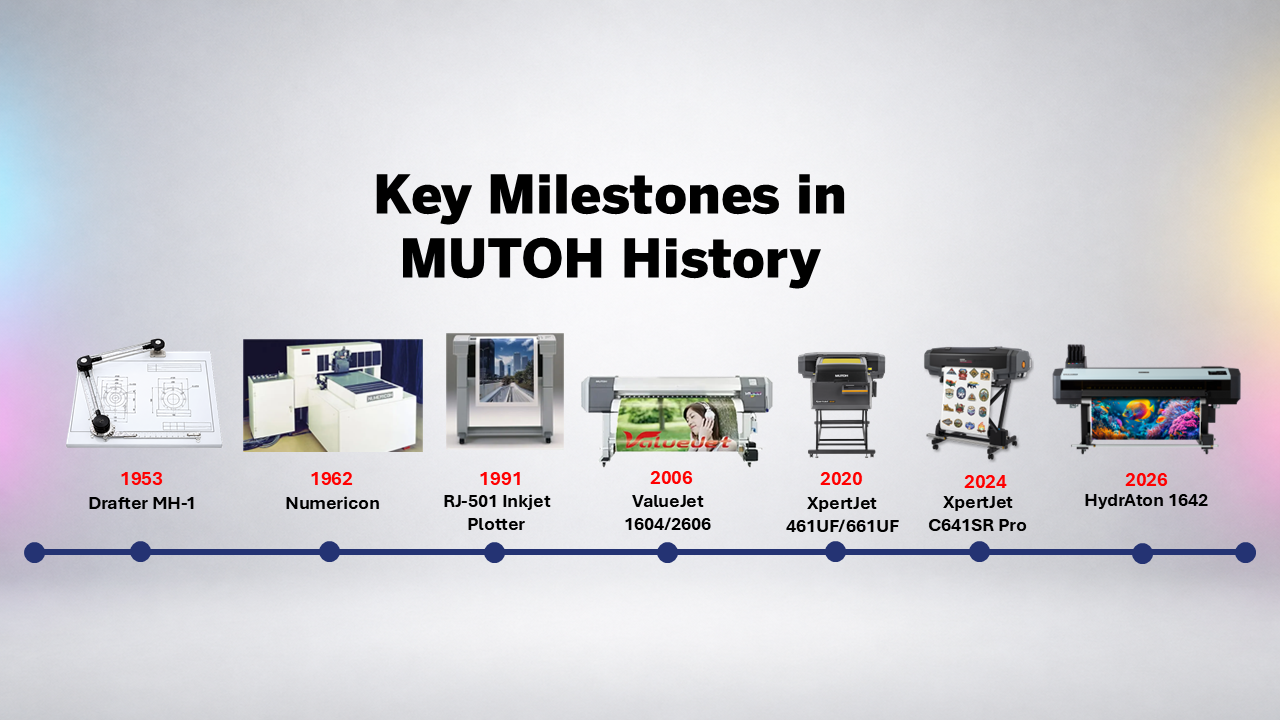
From mechanical drafting equipment to today’s digital inkjet printers, the story of MUTOH is one of precision engineering applied to new problems. Since its early days, MUTOH has introduced technologies designed to improve accuracy, print quality, productivity, and the range of applications businesses can produce.
What Did MUTOH Make Before Inkjet Printers?
Before entering the digital printing market, MUTOH developed precision measuring instruments, mechanical drafting equipment, and plotting machines. These products helped establish the engineering foundation behind its later printing technologies.
1952: MUTOH was established in March 1952 as MUTOH Memori Chokoku (MUTOH Scale Engraving) Ltd.
1953: The Drafter MH-1 was released as Japan’s first arm-type design and drafting machine.
1961: The Micro Plotter was introduced as a super-precision graphical input and drafting machine.
1962: MUTOH launched the Numericon, an automatic drafting machine that became a forerunner of modern plotting technology.
1967: The company introduced Japan’s first rail-type design and drafting machine.
1971: MUTOH released the world’s first design and drafting machine featuring a dial-type angle-reading system.
1976: Launched the world’s first design and drafting machine featuring a digital-type angle-reading system.
When Did MUTOH Start Making Large Format Inkjet Printers?
The transition into inkjet printing marked a significant step in the company’s history. It opened the door to new applications in advertising, signage, graphics, and commercial printing.
1991: MUTOH introduced the RJ-501, a large color inkjet plotter and an important step toward digital wide-format graphics production.
1995: The RJ-1300 Wide Format Color Inkjet printer was released for the indoor and outdoor advertising industry, becoming a large format inkjet printer built for sign production.
2006: Released the ValueJet 1204, followed by the ValueJet 1604 and VJ-2606, brought eco-solvent inkjet printing to the lineup.
2007: The ValueJet 1608 was introduced with MUBIOINK, an ink made with plant-based ingredients, expanding the range of ink technologies available for wide-format printing.
2010: MUTOH released MP Ink, a multipurpose ink formulated with 50% plant-based ingredients. It was designed for printing on various materials, expanding the range of compatible applications.
How Do Intelligent Interweaving (i²) and i-Screen Reduce Banding on ValueJet and XpertJet Printers?
MUTOH developed Intelligent Interweaving (i²), a patented printing technique that uses wave-like ink placement patterns instead of conventional straight-line patterns. By interlacing the print pattern, i² helps reduce visible banding while maintaining image quality at productive print speeds.
Building on this technology, MUTOH later developed i-Screen, an evolution of Intelligent Interweaving. i-Screen arranges ink dots by considering how they look. This reduces banding for smoother print images.
How Has the MUTOH Eco-Solvent Printer Evolved?
The evolution of the eco-solvent printer platform brought additional choices for businesses producing vehicle graphics, signs, decals, banners, and other applications.
The ValueJet generation developed into newer XpertJet models, adding MUTOH AccuFine printheads, DropMaster 2 for bi-directional alignment, and FeedMaster for media feed correction.
Today, the eco-solvent lineup includes:
- XpertJet C641SR Pro: A compact 24-inch integrated printer and cutter.
- XpertJet 1341SR Pro: A 54-inch eco-solvent printer for banners, stickers, decals, and window graphics.
- XpertJet 1641SR Pro II: A 64-inch platform designed for a range of wide-format applications.
- XpertJet 1681SR Pro: An eight-color printer for a wider color gamut.
- ValueJet 2638X: A 104-inch model for high-volume, superwide production for high-volume production.
How Has the MUTOH UV Flatbed Printer Technology Advanced?
The development of UV printing moved the brand into direct-to-object work. In 2014, MUTOH introduced the VJ-426UF and VJ-1626UH, followed by the VJ-1638UH UV-LED hybrid printer in 2016.
Today, the UV flatbed printer lineup includes the XpertJet 461UF, XPJ-661UF, XPJ-661UF Pro, and XPJ-1462UF, alongside multipurpose and hybrid platforms such as the ValueJet 628MP, VJ-1628MH, and VJ-1638UH Mark II.
Which Technologies Power the XpertJet UV Flatbed Printer?
Patented Local Dimming Control
In 2024, MUTOH received a patent for Local Dimming Control (LDC). This technology uses independently controlled sections of a UV-LED lamp to manage curing across the print area. It allows gloss, semi-gloss, and matte varnish effects to be produced alongside color and white ink in one pass.
By combining these effects in one pass, LDC helps reduce production time while minimizing issues such as banding and layer misalignment.
Lenticular 2.0
Another development for UV printing is Lenticular 2.0, introduced for the XpertJet 661UF. This patent-pending technology uses varnish to create lens structures over printed images, producing visual effects that change with the viewing angle.
Spot Lenticular 2.0 extends the technique by allowing lenticular effects to be applied to selected areas of a flat substrate. These capabilities open additional applications for specialty graphics, promotional products, and packaging.
How Did the Dye Sublimation Printer Lineup Grow From ValueJet to XpertJet?
MUTOH also developed printers for dye-sublimation production. The ValueJet 1638WX, introduced in 2013, was part of this development, followed by additional models designed for textile and transfer applications.
The current lineup includes the XpertJet 1341WR Pro, XpertJet 1642WR Pro and the ValueJet 2638WX.
These dye sublimation printers support applications such as soft signage, apparel, sportswear, and textile graphics.
What Is the HydrAton 1642 Water-Based UV Printer?
The HydrAton 1642 opened a new technology segment. It is a 64-inch roll-to-roll printer that combines water-based ink with UV curing, bringing together low-odor, low-VOC output and a cured film that resists scratching without an overcoat.
It runs AQUAFUZE™ ink, a UV-curable water-based ink, made using Fujifilm Group’s proprietary technology for stable water dispersion of photopolymers. Curing at 30°C to 50°C allows printing on heat-sensitive media, and the ink carries GREENGUARD Gold certification. AQUAFUZE is a registered trademark of FUJIFILM technology.
With applications that include wallpaper, signage, banners and car wraps home décor, and specialty media, HydrAton adds a different approach to the wide format printer market.
What’s Next for MUTOH Wide Format Printer Technology?
From the Drafter MH-1 to the HydrAton 1642, each generation solved a production problem: precision, banding, color consistency, finishing speed, or drying temperature. That same approach continues to shape every new wide format printer in the eco-solvent, UV, dye sublimation, and water-based UV lineups.
See the results on your own applications. Request a print sample or find your nearest authorized dealer.