Packaging is one of the fastest-growing segments in print, and brands of every size are looking for production partners who can move quickly.For print shops, the opportunity is clear: clients who need packaging prototyping want physical samples fast, on real materials, without the cost and delay of going through a separate vendor.
The shops that can deliver this in-house are the ones winning long-term client relationships, and the production work that follows.
Small Print Shops Now Have a Real Opportunity in Custom Packaging
Not long ago, packaging was largely the domain of specialty converters and large commercial printers. That has changed. The growth of small-batch custom packaging, driven by e-commerce brands, craft food and beverage companies, cosmetic startups, and direct-to-consumer retailers, has created strong demand for shorter runs, faster turnarounds, and more frequent design revisions.
Small and mid-sized print shops are well positioned to serve this market. They are agile, customer-oriented, and already proficient in color management and substrate handling.
What many lack is the in-house capability to produce packaging mock-ups and physical proofs, which is exactly what today's brand clients expect before approving any production run.
Why In-House Packaging Prototyping Is the Smartest First Move?
Adding full packaging production to a print shop's capabilities is a significant investment. But packaging prototyping is a far more accessible first step, and often a more profitable one. A physical prototype serves a specific, high-value function: it allows designers, brand managers, and retail buyers to evaluate how a package looks, feels, and performs before any tooling or production commitment is made.
When print shops own this step in the process, they integrate more deeply into their clients development workflows. This positioning directly leads to stronger, more loyal client relationships.
What Packaging Clients Expect from a Prototyping Partner?
Understanding what packaging clients actually need helps print shops scope the right investment and pitch the right service. The most common expectations are:
- Speed. Brand teams operate under tight deadlines. A prototype that takes two weeks from an external vendor stalls the entire development process. Same-week or next-day delivery is a genuine competitive advantage.
- Substrate accuracy. A proof on generic white paper tells a client almost nothing about how the final package will look on a metallic film, matte board, or shrink sleeve. Clients need output on the actual production material.
- Color fidelity. Approving packaging colors is vital, as it ensures compliance with brand standards, retail shelf requirements, and print consistency through precise color matching during the proof stage.
- Versatility. Most clients need more than one format. Folding cartons, labels, flexible packaging, corrugated inserts, and POP displays may all be part of a single product launch.
Print shops that can fulfill all four roles become essential, serving not merely as vendors but as collaborative creative and production partners.
How to Build a Packaging Printing Solution Your Clients Will Keep Coming Back To
The operational setup for in-house packaging prototyping does not have to be complicated. Most print shops already have the core competencies: file handling, color profiling, substrate feeding, and finishing. What typically needs to be added is a printer capable of handling a broader range of packaging substrates, and an ink system that maintains adhesion and flexibility across those materials.
A practical starting point is to build a substrate library based on what your current or target clients actually use in production. Stocking a selection of films, coated boards, label stocks, and corrugated materials allows the shop to proof on production-representative materials from day one. Pricing the service correctly matters just as much as the equipment. Packaging prototyping should not be treated as a free add-on.
Brands expect to pay for speed and accuracy, especially when the alternative is an external vendor with longer lead times and less substrate control. Positioning the service at a premium, with a clear value proposition around turnaround time and material fidelity, sets the right expectation from the first conversation.
Choosing the Right Wide Format Printer for Packaging Work
Hardware selection comes down to one core question: can this printer output on the same substrate my client will use in production?
General-purpose eco-solvent or standard inkjet printers often struggle because their inks are not specifically designed to adhere reliably to films, foils, and specialty boards used in packaging. The right wide format printer for packaging work needs multi-purpose or UV hybrid ink technology, sheet and roll media capability, and a color gamut wide enough to proof brand-critical colors accurately.
ValueJet 628MP: Proof Flexible Packaging on the Exact Production Substrate
The ValueJet 628MP is a 24-inch multi-purpose inkjet printer built around the needs of short-run prototyping. Its key advantage for packaging is the ability to print directly onto the exact substrate used in final production not an approximation, but the real material. It handles both roll and sheet media, allowing operators to feed packaging blanks, shrink film, label stock, and specialty boards without changing the workflow.
The VJ-628MP runs on MP31 multi-purpose ink, which maintains the true look and feel of each substrate while delivering strong adhesion, abrasion resistance, and color vibrancy on par with eco-solvent inks.
For flexible packaging and shrink applications, MP31 ink is flexible; it will not crack when the printed material is bent, folded, vacuum-formed, or heat-shrunk. Up to 8 colors, including optional spot colors like orange, blue, and green, support accurate brand color reproduction and smooth gradations.
ValueJet 1628 MH: Wider Format for Corrugated, POP Displays, and Custom Packaging
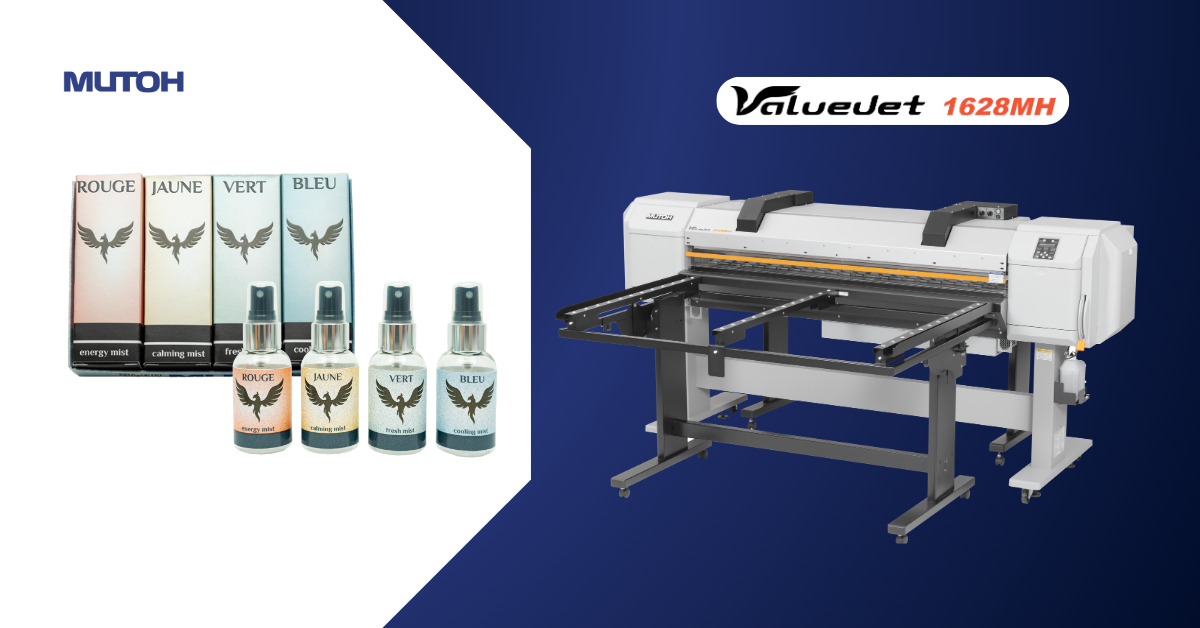
For shops that need a larger print width or white ink capability, the ValueJet 1628MH is the natural step up. This 64-inch multi-purpose hybrid printer features a wider carriage than the VJ-628MP, enabling it to handle larger packaging formats, full-panel corrugated prototypes, extensive POP displays, and oversized folding cartons.
The VJ-1628MH runs on the same MP31 multi-purpose ink as the VJ-628MP, delivering consistent adhesion, color vibrancy, and flexibility across a wide range of packaging substrates. Its wider carriage and enhanced 8-color print mode, including white ink capability, make it the stronger choice for larger-format applications and premium custom packaging that requires printing on dark, transparent, or metallic materials.
Powering both printers is MUTOH Award-Winning Genuine VerteLith™ RIP software, bundled with Flexi DESIGN MUTOH Edition, a $1,600.00 value included with every printer.
Start Offering Packaging Prototyping Before Your Competition Does
The opportunity to establish your shop as a leading packaging prototyping partner is available now, but it is limited. As more shops develop this ability, the competitive edge will move from just offering the service to delivering it more efficiently and quickly than others.
The shops investing now in the right wide format printer, the right ink technology, and a repeatable prototyping workflow are the ones building client relationships that will anchor their business for years.
Whether you're working with food and beverage brands, cosmetics companies, or specialty product manufacturers, in-house packaging prototyping provides your shop with a unique advantage that no price can match: the ability to deliver a physical, production-ready sample to a client before anyone else.
Request a Sample or Find a Dealer Near You
See how MUTOH print quality performs on your packaging substrates, request a free sample and experience the difference firsthand. Find your nearest MUTOH dealer and get expert guidance on building your in-house packaging prototyping capability.