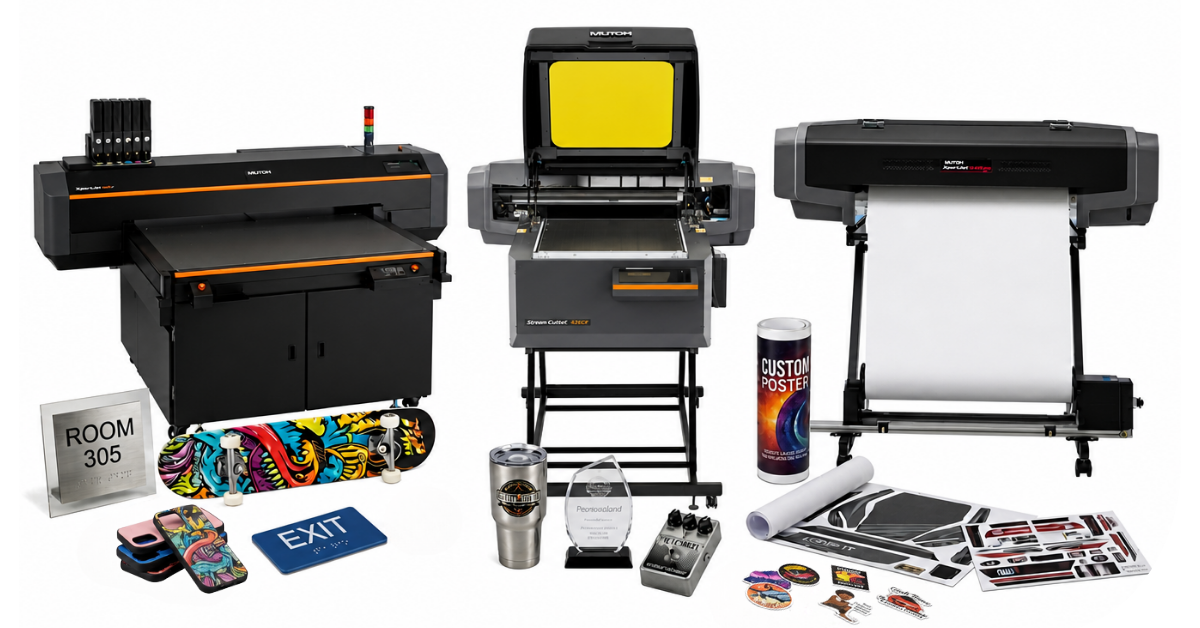
If you work in the print industry, you already know the requests don’t come in neatly sorted by media type. A single customer might need banners, decals, rigid signage, and promotional graphics, all for the same deadline. Meeting that demand often means juggling multiple devices or sending work out, which can introduce delays, color inconsistencies, and added cost. A UV hybrid printer offers another option: producing both rigid and roll applications on one machine, without forcing shops to choose one direction over the other.
For small to mid-sized print businesses, flexibility has become just as important as speed. Floor space is limited, staffing is tight, and customers expect quick turnarounds without compromising quality. Hybrid UV printing addresses those challenges by enabling shops to expand what they can produce without adding equipment.
What Hybrid UV Printing Really Means and Why It Matters
Hybrid UV printing is often described as “doing rigid and roll on the same machine,” but that definition only tells part of the story. In practice, a UV printer with hybrid capability is designed to handle different substrates using a shared workflow, consistent color management, and the same curing process. That consistency is what makes hybrid UV valuable in day-to-day production.
UV inks cure instantly under UV light, which means prints are dry and ready to handle as soon as they come off the printer. Whether the job is printed on rigid board or flexible media, the output remains stable and predictable. For shops producing multiple assets within a single order, that reliability matters.
This capability is especially relevant now, as more customers expect shops to deliver coordinated branding across multiple formats. Being able to move from rigid retail signage to roll-based graphics without switching devices helps reduce production friction and keeps color looking consistent from start to finish.
The MUTOH ValueJet1638UH Mark II is built around this hybrid approach. It supports both rigid and roll media in one system, giving shops a way to adapt their production without overhauling their workflow.
Why Hybrid UV Fits How Print Shops Actually Operate
Most print shops are not set up around one type of job. Production schedules change daily, and priorities shift quickly. A hybrid UV system fits that reality by allowing operators to pivot between applications without major setup changes.
Instead of dedicating floor space to multiple printers, shops can consolidate output into a single platform. This can simplify training, maintenance, and scheduling, areas that often become pain points as a business grows. It also makes it easier to take on mixed-media orders without worrying about mismatched results.
For shops already producing acrylic signs alongside banners or decals, hybrid UV printing makes those transitions more manageable and more profitable.
From Capability to Revenue: One Printer, Multiple Paths
The biggest advantage of hybrid UV printing is not just what it prints, but what it allows shops to say “yes” to. When rigid and roll work can be produced in-house, new revenue opportunities tend to follow.
With a hybrid platform, shops can produce banners, decals, rigid panels, and vinyl signs using a single production process. That makes it easier to offer bundled solutions, such as event signage packages or coordinated retail graphics, without adding complexity behind the scenes.
Expanding Existing CustomerRelationships
Many print shops already serve customers who regularly order roll-based graphics. Hybrid UV printing makes it possible to offer rigid signage to those same customers without outsourcing. That keeps production under one roof and helps preserve margins.
This is where custom signs often come into play. Interior branding, promotional displays, and wayfinding pieces are frequently ordered in small quantities, but they carry higher value. Producing them in-house gives shops more control over timelines and quality while strengthening customer relationships.
Short Runs, Specialty Jobs, andSeasonal Work
Short-run work is where hybrid UV printing really proves its worth. Shops can produce one-off pieces, limited campaigns, or seasonal promotions without dedicating a separate device to the task. That flexibility reduces risk when testing new applications or markets.
Jobs like yard signs, promotional boards, and temporary displays often fall into this category. They may not justify dedicated equipment, but they can be profitable when produced efficiently. Hybrid UV printing allows shops to take on that work without disrupting their core production.
The ValueJet1638UH Mark II supports this kind of mixed production, making it easier for shops to balance routine work with specialty requests.
Flexibility as a Long-TermStrategy
Hybrid UV printing does not require shops to abandon what they already do well. Instead, it provides a way to build on existing services. Roll-to-roll production can remain the foundation, while rigid applications are added as customer demand grows.
By reducing the need for multiplemachines, a UV hybrid printer becomes part of a broader growth strategy, onethat prioritizes adaptability over specialization. For many shops, that balanceis what allows them to grow sustainably.
Moving Forward With Hybrid UV Printing
Hybrid UV printing is not about replacing equipment or changing business models overnight. It is about removing barriers that limit what shops can offer. The ValueJet1638UH Mark II provides a practical way to combine rigid and roll production in one workflow, helping shops respond to changing customer needs.
For print businesses looking to expand capabilities without expanding their footprint, hybrid UV printing offers a clear path forward. Request a sample or find a dealer to see how this approach fits into your production environment.